Chattermarks

From North Cascades Institute

Search Chattermarks

2012 Catalog

Archives

Fall Vignettes from the Institute

October 23rd, 2011 | Posted by in Institute News

People experience the seasonal transformations of the natural world in a myriad of ways. Each of us may recognize subtleties taking hold of a landscape in times of change that others will miss completely because they have learned to pay attention to different details. Amidst downpours of rain in the lowlands and dustings of snow in the mountains, it can be easy to settle in to quieter and more thoughtful routines. It can be easy to put our noses in books and our feet in slippers, forgetful that these changes bring new forms of burgeoning and often unnoticed life back into the world.

For some, these changes affect most the olfactory realm, delighting that sense with smells of duff and rich, turning soils. For others, it is the sight of a golden larch contrasted against crystalline snow and mountain peaks, and still others notice most the mosses of the forest floor amplified to new shades of green by the quickening rains. Perhaps for some it is the elongated light and the shadows that persist which give new meaning to the color and character of the trees. Or some may simply feel it as an urgent knowing from deep within, a connection to the undercurrents of a timeless, cyclical change.

By combining our individual morsels of detail and thought about the essential elements of fall, we are able to paint a richer understanding of this place in which we live. We are able collectively to tell a story that captures the beauty of the changing seasons in the North Cascades ecosystem. In the process, we learn to draw on other’s knowledge in order to widen our own, ultimately coming to appreciate a more communal understanding of place. Below, staff and graduate students share their own unique vignettes of fall, offering perspectives of this region that span many seasons to just a few months.

Tigerlily pods ready to sow their seeds on the fecund soils of the Methow Valley. Photo by Jess Newley.

» Continue reading Fall Vignettes from the Institute

Watercolors in the North Cascades

October 21st, 2011 | Posted by in Institute News

Earlier this October, Seattle artist and North Cascades Institute friend Molly Hashimoto led a wonderful and successful workshop on watercolor painting in nature at the Environmental Learning Center. Each day, Molly led students through exercises that developed tangible skills and techniques with the aim of guiding individuals towards their own unique artistic expressions. Molly and her students spent time in and around the Environmental Learning Center and along Washington Pass, finding inspiration in the many angles, elevations, and dramatic hues of the North Cascades. Below is a painted story highlighting the beautiful work of many of the workshop’s participants. A big thank you to Molly and to all who attended!

Check out Molly Hashimoto’s blog for a full recounting of her experience while teaching watercolors at the Environmental Learning Center.

» Continue reading Watercolors in the North Cascades

See the wild side with new North Cascades tours

August 10th, 2011 | Posted by in Field Excursions

Seattle City Light’s Skagit Tours has added a guided van-and-hiking day tour of its Skagit hydroelectric project and nearby falls, gorges and viewpoints of the North Cascades. Photo by Jessica Haag.


By Mike McQuaide Originally published in The Seattle Times, August 3, 2011

Atop Diablo Dam, in the heart of the North Cascades, Sara Beaver unscrewed the top of her water bottle and, holding it out at arm’s length, prepared to demonstrate the dam’s unique anti-gravity properties.

“I’ve never tried this before,” said the North Cascades Institute naturalist, “but I’ve heard that it’s impossible to pour water down the front of the dam.”

Holding her bottle over the edge of the 389-foot-high dam, she tilted the bottle and poured. But instead of the water falling straight down as the law of gravity, as well as personal experience, would lead one to expect, the water sprayed horizontally, right back at her. Almost like she was squirting herself in the face with a garden hose.

Explanation for this “Mythbusters” myth confirmed-type moment? Westerly winds barreling down narrow Diablo Gorge run head-on into the front of the dam’s massive concrete wall (at one time it was the highest dam in the world) and have nowhere to go but up. So does something relatively light, like water from a bottle.

“It’s kind of a microcosm of the weather out here,” offered Daphnie Leigh, an interpretive ranger with North Cascades National Park, who was also with us atop the dam.

“Clouds coming in off the Pacific Ocean hit the mountains and, just like the wind has nowhere to go when it hits the dam, they rise and eventually cool, releasing all their moisture in the form of snow and rain.”

Ah, learning. Cool. We were spending our day on North Cascades Expeditions, a new-this-summer tour, combining van rides and short hikes, offered as part of the Skagit Tours operation of Seattle City Light, which operates this hydroelectric dam. Like Beaver, Leigh was providing various and sundry answers to the area’s hows, whys, whats and whens on this six-hour guided foray through this truly spectacular Upper Skagit-North Cascades part of the world.

» Continue reading See the wild side with new North Cascades tours

The Cascades Butterfly Project: Citizen Scientists Unite!

August 1st, 2011 | Posted by in Institute News

On July 23rd, a group of volunteer scientists joined biologists from the North Cascades Institute, North Cascades National Park and Western Washington University to say farewell to “the winter that would never end” by kicking off the Cascades Butterfly Project.

The Cascades Butterfly Project is a collaborative effort between biologists and citizen scientists, who will work together to monitor butterfly populations throughout North Cascades National Park, Mount Rainier National Park, and Mount Baker-Snoqualmie National Forest. 
After a brief classroom session where we reviewed the basics of butterfly ecology and identification, we headed to Sauk Mountain to test our new skills and learn the field study techniques we’ll use to gather this important data.

Satyr Comma perched on the thumb of photographer, graduate student, and volunteer wildlife biologist, Elise Ehrheart.

Mountain ecosystems are particularly vulnerable to climate change, with alpine meadows expected to shrink dramatically throughout the Cascades Mountain Range. Butterflies make ideal indicator species of alpine ecosystem health because they are particularly sensitive to climatic changes, and are relatively easy to identify in the field by scientists and volunteers alike.

Hiking home after a successful day in the field

If you’re interested in joining in on this exciting (and fun!) research, it’s not too late, and no previous scientific experience is necessary.  There will be another volunteer training at Mount Rainier National Park on August 13. For more information, contact North Cascades Institute’s Science Coordinator, Jeff Anderson, at jeff_anderson@ncascades.org or (206) 526-2574.

25th Anniversary posters for sale

July 28th, 2011 | Posted by in Institute News

We are pleased to offer a special limited-edition poster commemorating North Cascades Institute’s 25th anniversary. This high-quality poster features a new painting by watercolor artist Molly Hashimoto, who also is the featured artist on our catalog this year and is teaching two workshops at the Learning Center. Her piece depicts an iconic view from the Learning Center of Pyramid Peak, Diablo Lake and a detail of Diablo Dam.

We’re selling these posters for $10 in all five of our bookstores, including the Learning Center, Stehekin, Newhalem and Marblemount. We’re also making them available to purchase by phone or email for $15 includes tax and shipping/handling).

To purchase one of these keepsake posters from afar, please email nci@ncascades.org or call (360) 854-2599. All of the proceeds from the sale of these posters will help us to fund outdoor education opportunities for local youth!

Here’s Molly sharing some thoughts on her painting and this particular view:

» Continue reading 25th Anniversary posters for sale

Institute recognized with NPS award

July 19th, 2011 | Posted by in Institute News

By Kurt Repanshek, originally published in National Parks Traveler July 7, 2011.

For a quarter-century the North Cascades Institute has been working in partnership with the National Park Service to educate the public on the wonders of North Cascades National Park and its surrounding ecosystem. Those 25 years haven’t been overlooked by the Park Service, which recently honored the institute for its work.

Park Service Director Jon Jarvis and North Cascades Superintendent Chip Jenkins visited the North Cascades Institute in late June to present its leaders with a Certificate for Outstanding Partnership Achievement. The two presented the award to Saul Weisberg, the Institute’s executive director, at a special ceremony on June 22.

“North Cascades Institute and North Cascades National Park have worked together for the past 25 years to help people conserve and enjoy this special place,” said Superintendent Jenkins. “This partnership is critical to the long term well-being of the North Cascades and we look forward to it continuing to grow in the next 25 years.”

Mr. Weisberg founded North Cascades Institute in 1986, along with key park staff including Director Jarvis, who served as the park’s chief resource manager early in his career.

The Institute’s mission is to conserve and restore Northwest environments through education. It operates a number of award-winning education programs for people of all ages, including Mountain School, North Cascades Wild, Cascades Climate Challenge, and a graduate program in partnership with Western Washington University. In 2005 the institute opened its Environmental Learning Center located in the North Cascades National Park Complex.

“We are honored that this important work has been recognized by the National Park Service,” said Mr. Weisberg. “Creating the next generation of public lands stewards has never been more important.”

Summer Youth Preparation Begins!

June 10th, 2011 | Posted by in Institute News

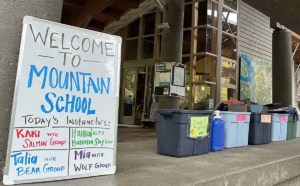
Mountain School is not yet over but the summer youth program team is already pulling big shifts and long hours in preparation for the arrival of the Cascade Climate Challenge and North Cascades Wild students. Countless calories must be packed and cached, payloads of gear have to be inventoried, cleaned and organized and mounds of student information needs to be reviewed and entered into spreadsheets. We assembled a few photos shot during the week to give folks a behind-the-scenes look into summer youth programs.

Ian, Amy and Kevin review equipment options.
(12 x 10 x 8) + (2 x 20 x 4) = ??? Tasha evaluates the food-packing progress.
Ian and Scott inventory and grade the condition of the equipment.
Amy outlines the structures and goals of the two summer youth programs in a presentation to new staff.
Still smiling, Kate prepares a bucket to be cached at the Ross Lake Resort.
Ian lays out the objectives of an instructor skills session.
One of the many spreadsheets and organizational charts we create and use.
102, 103, 104… Program T-shirts are inventoried.
Still packing food. Clint orders Codi to quit dancing and get back to work. Fortunately, she is ignoring him.
Photos by Megan McGinty and Codi Hamblin


Richard Louv & the Nature Principle

May 11th, 2011 | Posted by in Institute News

Please join North Cascades Institute and REI as we present Richard Louv, author of Last Child in the Woods and co-founder of the Children & Nature Network, Thursday, May 12; 7 p.m. at Town Hall, Seattle and Friday, May 13; 7 p.m. at Sehome High School, Bellingham. Tickets available online or at the door; information at www.ncascades.org/events.

Co-sponsored by US Forest Service, Village Books, Sierra Club, ParentMap and the Bellingham Herald.

A Conversation with Richard Louv

Q: Why did you decide to follow up on the successful Last Child in the Woods?

A: Once in Seattle, while I was giving a talk, a woman said, “Listen to me, adults have nature-deficit disorder, too.” She was right. In Last Child in the Woods, I introduced that term, not as a medical diagnosis, but as a way to describe the growing gap between children and nature. By its broadest interpretation, nature-deficit disorder is an atrophied awareness, a diminished ability to find meaning in the life that surrounds us, whatever form it takes. This shrinkage of our lives has a direct impact on our physical, mental, and societal health.

Over the last few years, I’ve heard many adults speak with heartfelt emotion, even anger, not only about the deficit for children but about their own as well. The Nature Principle is not age-specific. It has a much broader scope and includes the latest research related to nature’s impact on human beings, as well as accounts of the personal discoveries of poets, artists, scientists and other thinkers.

What is the “Nature Principle?”

The Nature Principle holds that a reconnection to the natural world is fundamental to human health, well-being, spirit, and survival, and that the more high-tech our lives become, the more nature we need. This book suggests how we can apply the principle to where we live, work, learn, and play, and asks, What would our lives be like if our days and nights were as immersed in nature as they are today in technology? And how can each of us help create that life-enhancing world, not only in a hypothetical future but right now for our families and for ourselves?

So, we all need to move to the country?

No. The Nature Principle can be applied in our cities, suburbs, homes, and workplaces. In 2008, for the first time in human history, more than half the world’s population lives in cities and towns. What that means is that if human beings are going to have a meaningful relationship with the natural world, that relationship will likely take place in urban areas, but this will require new kinds of cities and towns. There’s a growing urgency.

Why the urgency?

» Continue reading Richard Louv & the Nature Principle

The merry (and busy!) month of May

May 5th, 2011 | Posted by in Field Excursions

This month, our 25th anniversary year really starts hopping with a wide range of public events, field excursions, readings, open houses and the first family getaway of 2011. Here’s a round-up of what we’re doing — read on and see how you can plug in.

May 6: Book release party for Ana Maria Spagna’s Potluck: Community on the Edge of Wilderness
Reading, book sales and hor d’eouvres at the Libation Station in Mount Vernon, 5 pm, free!
www.ncascades.org/more_info/news/detail.html?news_id=2189

May 7-8: The History of the Legendary F-Style Mandolin with Stan Miller and John Reischman
Join Bellingham resident and master luthier Stan Miller as he shares his experiences in constructing of one of the most revered stringed-musical instruments ever developed. In our first-ever musical Sourdough Speaker event, mandolin legend John Reischman (Tony Rice Unit, The Jaybirds) will join Stan to demonstrate the range of sounds that these exquisite instruments are capable of producing. As Stan tells the fascinating story of the mandolin in words and images, John will provide a soundtrack of tunes, techniques and commentary.
www.ncascades.org/speakerseries

May 12 (Seattle’s Town Hall) and May 13 (Bellingham’s Sehome High School): Richard Louv
Hear the author of the best-selling book “Last Child in the Woods: Saving our Children from Nature-Deficit Disorder” introduce his latest publication, “The Nature Principle: Human Restoration and the End of Nature-Deficit Disorder.” The Seattle event will feature an environmental education fair with over 20 organizations and a special on-stage conversation between Louv and Pulitzer Prize-winning journalist William Dietrich.
www.ncascades.org/events

May 12 and May 14: Mountain School Open House
Join us to learn more about this award-winning residential environmental education program Thursday, May 12, 9am-4pm or Saturday, May 14, 9am-4pm. We’ll meet at our office in Sedro-Woolley and travel up the Skagit River together to our wilderness campus for a tour of our LEED-certified facility and a chance to meet Mountain School staff. Thursday attendees will have the opportunity to observe the Mountain School program in action. We’ll provide a hot lunch in our Dining Hall and organize transportation.
http://www.ncascades.org/more_info/news/detail.html?news_id=2188

May 14-15: Naturalists’ Delight: Spring Magic in the Methow
Join us for a weekend outdoor adventure with local naturalist Dana Visalli, editor of The Methow Naturalist and an attentive resident of the Methow for four decades. Meandering through the aspen-laced hills with all of our senses open, we’ll learn the basics of identifying the bewildering array of plants, mushrooms and mosses at our feet, while keeping an eye to the sky for birds, butterflies and bugs.
http://www.ncascades.org/programs/seminars/course.html?workshop_id=1042

May 20-22: Learning Center Stewardship Weekend
Join the National Park Service and Institute naturalists to tend to native flora and the habitat surrounding the Learning Center. You are invited to form a relationship with this piece of the planet by contributing to its well being by way of shovel, shears and some elbow grease. We’ll have a variety of projects for all abilities and we’ll provide all of the tools too. Your hard work will be rewarded when our talented kitchen staff serves up hearty and delicious meals. After a satisfying day of giving back to the earth, give yourself a treat and head out for a sunset stroll, relax in our library or spend an evening around the campfire sharing stories of this place. $50 suggested donation.
http://www.ncascades.org/programs/seminars/course.html?workshop_id=1043

May 24: Wendell Berry in Seattle
Critics and scholars have acknowledged Wendell Berry as a master of many literary genres, but whether he is writing poetry, fiction, or essays, his message is essentially the same: humans must learn to live in harmony with the natural rhythms of the earth or perish. Join North Cascades Institute and Seattle Arts & Lectures for our annual “Wilderness and Imagination” event at Seattle’s Benaroya Hall.
www.ncascades.org/events

May 28-30: Memorial Weekend Family Getaway
As spring emerges in the mountains with longer days and explosive green growth, gather your family in the North Cascades for a slate of engaging, hands-on activities including big canoe paddling, hiking local trails, outdoor games and nature crafts, campfires at nights and delicious meals in our lakeside dining hall.
www.ncascades.org/family

And coming up in June….

June 3-5: Spring Birding Weekend
Discover the diversity of avian life that wings into the Pacific Northwest every spring during its annual migration from Mexico and Central and South America to summer grounds in the north. Joining expert birders Libby Mills and Tim Manns, we’ll gain deeper awareness of those wonderful creatures that bring beauty and song to our days. We’ll explore forests, meadows and mountain streams in the Methow and Skagit valleys, spending the first night at the Learning Center on Diablo Lake and the second night camping in the Methow Valley.
http://www.ncascades.org/programs/seminars/course.html?workshop_id=1044

More programs, information and registration at www.ncascades.org/get_outside or (360) 854-2599.

Ana Maria Spagna’s “Spawning in the Mud”

May 2nd, 2011 | Posted by in Institute News

Editor’s note: The following is an excerpt from Institute writing instructor Ana Maria Spagna’s new collection of essays Potluck: Community on the Edge of Wilderness. Join us at Mount Vernon’s Libation Station on May 6 for a free reading and author reception — more information on this and other readings in Seattle, Concrete, Darrington and elsewhere at www.ncascades.org.

*  *  *  *  *  *  *  *  *  *  *  *  *  *  *  *  *  *

All summer the threat of a catastrophic wildfire had cast a pall over the valley. Ferns browned up and bowed over. Twigs snapped under Vibram soles, and we winced.  I’d spent so much dread on wildfires that I’d forgotten completely about floods. Besides, after that 100-year flood eight years back, didn’t we have a 92 year hiatus coming?

“Come on,” Laurie said.

She pointed to my boots strewn where I’d left them after my last day of trail work. I pulled them on, and we headed out. The extension cords in the yard were now completely submerged and barely visible. The earth had been too dry for too long, and now it would not accept water, but repelled it, dust-like, so that the whole forest floor was filling up like a series of plastic kiddy pools. Hydrophobic, people would say later: the soil had gone hydrophobic.

Laurie and I splashed on through. As we neared the river, the puddles began moving in rivulets that divided and spread like a crowd racing for their cars after a ball game. We stood on the bank with our camera and waved at neighbors and schoolkids standing on the opposite bank. Laurie jumped up and down and clapped as water sprayed over the top of a small log jam, like surf over tide pools. The kids mimicked her.

I stood still.

The air buzzed with excitement, but I resisted. Sure, as a seasonal laborer on backcountry trail crews, I’d been free to give in to it. We cheered when trail bridges washed out; if it meant more work for us, so be it. Nature wins! we’d say.  And we believed it. The river not only had more might than us, I figured back then, but more right, too. Once, when I worked in Canyonlands in Utah, a visitor had knocked at my door in the middle of the night to tell me about a rattlesnake she’d seen in the backcountry. Someone should do something about it, she said. The park belongs to the rattlesnakes, I said, and I shut the door. For many years I believed something similar about floods. The valley belongs to the river. The difference, of course, was that now that we’d settled down and bought land and built a home, we belonged to the valley too.

On our way back home, a familiar pickup slowed next to us.

“I think it’s gonna get wild,” the driver said.

» Continue reading Ana Maria Spagna’s “Spawning in the Mud”