Chattermarks

From North Cascades Institute

Search Chattermarks

2012 Catalog

Archives

Summer Youth Recon 2011

June 27th, 2011 | Posted by in Field Excursions

After a week of food and gear packing, the Summer Youth team ventured to Ross Lake for the annual recon trip. The purpose of the trip was to transport food and gear to Ross Lake Resort for the summer, familiarize ourselves with the lakeside campgrounds, learn program curriculum and test out the camping gear and food menu. This year the recon was a bit different as leaders from both Cascades Climate Challenge and North Cascades Wild joined forces on the lake, allowing us all to better get to know each other and the program content we’ll each will be involved with.

The crew began the trip by loading the canoes with bucketfuls of food and personal gear at the North Cascades Environmental Learning Center, where we eventually departed. The group paddled through the gorge in Diablo Lake toward Ross Dam. At the first destination we pulled canoes from the water and carried gear and buckets to meet our shuttle who would portage our gear to Ross Lake Resort. Once at the resort we stored our food for the summer, met with resort staff and prepared for an afternoon of paddling to McMillan Camp, our first destination of the trip.

Kate and Ian fill canoes with bucketfuls of food that will be stored at Ross Lake Resort.

» Continue reading Summer Youth Recon 2011

Summer Kicks Off with Stewardship

June 10th, 2011 | Posted by in Field Excursions

I have a motto for hiking in the Northwest: “I may not get a tan, but at least I’ll get a shower.” This winter did nothing but confirm my beliefs. During the longer-than-usual dark months of rain falling outside my office, I sat at my desk planning volunteer projects in the hopes that the sky would someday dry. Lo and behold, it did.

On May 28th we had our kickoff day for a brand new North Cascades Institute program, North Cascades Stewards. The first event was held in Marblemount at the North Cascades National Park Native Plant Nursery. And guess what, there was some sunshine. The weather was finally warm enough for me to take off my jacket and work in short sleeves. Spring showers may later have forced me to put my hood back on, but for a blissful 30 minutes, I worked outside in the balmy 60-degree weather, soaking in the sun’s rays. It was there in Marblemount that I sat under a patchy blue sky and started the program I had been planning for so many months. The birds were chirping, the leaves bright green with buds, the air heavy and laden with the sweet smell of cottonwood trees, together, these things added up to the change of the seasons.

North Cascades Stewards bear their tools have working in the nursery.

Reveling in this glimpse of spring, me and seven volunteers got our hands dirty, pulling non-natives and edging the beds of the garden. National Park employees Cheryl Cunningham and Mike Brondi led us in maintaining the garden and taught us about wilderness management. Soon the beds we maintained will be used to grow native plants to restore the Park. This simple day of stewardship marked the beginning of our summer volunteer season.

» Continue reading Summer Kicks Off with Stewardship

The merry (and busy!) month of May

May 5th, 2011 | Posted by in Field Excursions

This month, our 25th anniversary year really starts hopping with a wide range of public events, field excursions, readings, open houses and the first family getaway of 2011. Here’s a round-up of what we’re doing — read on and see how you can plug in.

May 6: Book release party for Ana Maria Spagna’s Potluck: Community on the Edge of Wilderness
Reading, book sales and hor d’eouvres at the Libation Station in Mount Vernon, 5 pm, free!
www.ncascades.org/more_info/news/detail.html?news_id=2189

May 7-8: The History of the Legendary F-Style Mandolin with Stan Miller and John Reischman
Join Bellingham resident and master luthier Stan Miller as he shares his experiences in constructing of one of the most revered stringed-musical instruments ever developed. In our first-ever musical Sourdough Speaker event, mandolin legend John Reischman (Tony Rice Unit, The Jaybirds) will join Stan to demonstrate the range of sounds that these exquisite instruments are capable of producing. As Stan tells the fascinating story of the mandolin in words and images, John will provide a soundtrack of tunes, techniques and commentary.
www.ncascades.org/speakerseries

May 12 (Seattle’s Town Hall) and May 13 (Bellingham’s Sehome High School): Richard Louv
Hear the author of the best-selling book “Last Child in the Woods: Saving our Children from Nature-Deficit Disorder” introduce his latest publication, “The Nature Principle: Human Restoration and the End of Nature-Deficit Disorder.” The Seattle event will feature an environmental education fair with over 20 organizations and a special on-stage conversation between Louv and Pulitzer Prize-winning journalist William Dietrich.
www.ncascades.org/events

May 12 and May 14: Mountain School Open House
Join us to learn more about this award-winning residential environmental education program Thursday, May 12, 9am-4pm or Saturday, May 14, 9am-4pm. We’ll meet at our office in Sedro-Woolley and travel up the Skagit River together to our wilderness campus for a tour of our LEED-certified facility and a chance to meet Mountain School staff. Thursday attendees will have the opportunity to observe the Mountain School program in action. We’ll provide a hot lunch in our Dining Hall and organize transportation.
http://www.ncascades.org/more_info/news/detail.html?news_id=2188

May 14-15: Naturalists’ Delight: Spring Magic in the Methow
Join us for a weekend outdoor adventure with local naturalist Dana Visalli, editor of The Methow Naturalist and an attentive resident of the Methow for four decades. Meandering through the aspen-laced hills with all of our senses open, we’ll learn the basics of identifying the bewildering array of plants, mushrooms and mosses at our feet, while keeping an eye to the sky for birds, butterflies and bugs.
http://www.ncascades.org/programs/seminars/course.html?workshop_id=1042

May 20-22: Learning Center Stewardship Weekend
Join the National Park Service and Institute naturalists to tend to native flora and the habitat surrounding the Learning Center. You are invited to form a relationship with this piece of the planet by contributing to its well being by way of shovel, shears and some elbow grease. We’ll have a variety of projects for all abilities and we’ll provide all of the tools too. Your hard work will be rewarded when our talented kitchen staff serves up hearty and delicious meals. After a satisfying day of giving back to the earth, give yourself a treat and head out for a sunset stroll, relax in our library or spend an evening around the campfire sharing stories of this place. $50 suggested donation.
http://www.ncascades.org/programs/seminars/course.html?workshop_id=1043

May 24: Wendell Berry in Seattle
Critics and scholars have acknowledged Wendell Berry as a master of many literary genres, but whether he is writing poetry, fiction, or essays, his message is essentially the same: humans must learn to live in harmony with the natural rhythms of the earth or perish. Join North Cascades Institute and Seattle Arts & Lectures for our annual “Wilderness and Imagination” event at Seattle’s Benaroya Hall.
www.ncascades.org/events

May 28-30: Memorial Weekend Family Getaway
As spring emerges in the mountains with longer days and explosive green growth, gather your family in the North Cascades for a slate of engaging, hands-on activities including big canoe paddling, hiking local trails, outdoor games and nature crafts, campfires at nights and delicious meals in our lakeside dining hall.
www.ncascades.org/family

And coming up in June….

June 3-5: Spring Birding Weekend
Discover the diversity of avian life that wings into the Pacific Northwest every spring during its annual migration from Mexico and Central and South America to summer grounds in the north. Joining expert birders Libby Mills and Tim Manns, we’ll gain deeper awareness of those wonderful creatures that bring beauty and song to our days. We’ll explore forests, meadows and mountain streams in the Methow and Skagit valleys, spending the first night at the Learning Center on Diablo Lake and the second night camping in the Methow Valley.
http://www.ncascades.org/programs/seminars/course.html?workshop_id=1044

More programs, information and registration at www.ncascades.org/get_outside or (360) 854-2599.

Winter Treasures of the Skagit Valley

January 11th, 2011 | Posted by in Field Excursions

There’s a sense of amazement that overcomes me each winter when I approach a muddy farm field turned white. It’s not from snow, per se, but snow geese, who travel hundreds of miles from their Siberian nesting grounds to winter and feed in the lower Skagit Valley. The fields this time of year, particularly near Fir Island, come alive with a buzz of honks and squawks as flocks numbering in the thousands cover the landscape and fill the sky as they come and go.

“Thousands of snow geese taking off from a field is one of the most spectacular sights one can imagine,” says Howard Armstrong, a Skagit Audubon member who has birded in the Skagit Valley for 40 years.

Top: An enormous flock of snow geese is a common sight during the winter months in the Skagit Valley. Photo by Christian Martin. Above: Snow geese return to the large farm fields in Skagit each year to feed on cover crops. Photo by Codi Hamblin.

Snow geese migrate to Skagit County each winter from their Arctic breeding grounds of summer. Photo by Codi Hamblin.

But snow geese are only one of several species who winter in Skagit County. Other birds include the thousands of trumpeter and tundra swans who leave their boreal and arctic pond breeding grounds in Alaska and Canada to feed on the open crop fields. The trumpeter swan, Howard says, was nearly extinct at the turn of the 21st Century, but this largest of north american waterfowl can now be seen in the Skagit Valley.

» Continue reading Winter Treasures of the Skagit Valley

Wildflower photography with Mark Turner

August 13th, 2010 | Posted by in Field Excursions

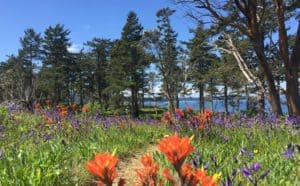
It’s hard to imagine a more inspiring place than the blooming, alpine meadows of the North Cascades to take a wildflower photography class, or a better instructor than Mark Turner, co-author of the Wildflowers of the Pacific Northwest handbook.

On July 19-21st with 15 photographers under his wing Mark embarked on a 3-day wildflower photography workshop. On day 1 we did class work (ie: learning your camera and some tips and techniques) and on days 2-3 we undertook amazing hikes and field excursions to implement what we learned.

» Continue reading Wildflower photography with Mark Turner

An Institute ode to summer

June 25th, 2010 | Posted by in Field Excursions

The transition from spring to summer has been a long awaited and hopeful one to those of us living in the Pacific Northwest this year.

This past week, our hopes have finally been fulfilled as the summer sun no longer conceals itself from behind overcast skies and the snow so prevalent upon the high peaks surrounding North Cascades Institute‘s Environmental Learning Center melts away to reveal the rocks of this rugged landscape. One of the best ways to take in and experience the summer in the North Cascades and Skagit Valley is to go hiking, to see places you have not seen before!

As a way to welcome the season of summer in the North Cascades and Skagit Valley, several staff, graduate students, and board members of North Cascades Institute hope to inspire you to enjoy this beautiful onset of summer weather by sharing their favorite hikes in the region of the Skagit Valley and North Cascades.

Ptarmigan Ridge Traverse – Mount Baker-Snoqualmie National Forest

A favorite trail, after 40 years and perhaps 400 hikes! An impossible task! Nonetheless, one favorite takes me out the east face of Table Mountain from Artist Point, then onto Ptarmigan Ridge. The trail winds along the ridge, slowly rising as it traverses the east slope of Coleman Pinnacle, then winds around to Lasciocarpa Ridge and ends at The Portals. Pass through The Portals and step onto a Mount Baker glacier. The scenery on this hike—when it is not cloaked in fog and cloud—is simply amazing! On the way out, Mt. Shuksan looms over the left shoulder and Mt. Baker soars upward straight ahead. Marmots whistle and pikas squeak. Pink and yellow monkeyflowers nod over the trickles and seeps, and groves of lupine wave in the mountain breeze. If you know where to look, mountain goats are nearly guaranteed, resting in small groups in the meadows (or on snowfields on hot summer days), the nannies and kids in small herds, the billies solitary on shaded ledges in unlikely places often high on the rock walls and ridges. A winter trip out this trail is also possible, with skis the best way to go and always with an avalanche transponder. The winter scenery is fantastic, but the risks are a bit greater. Lots of people make it part way out this trail in late summer and fall. The section along the east face of Table Mountain is perhaps the most heavily traveled trail in the entire North Cascades, but most do not go beyond the fork to Chain Lakes. If you don’t want to share this remarkable place, go in winter, but do go!

~John Miles, North Cascades Institute Board Member

» Continue reading An Institute ode to summer

Bunchgrass Dreams : High Desert Ecology with Mark Darrach

April 15th, 2010 | Posted by in Field Excursions

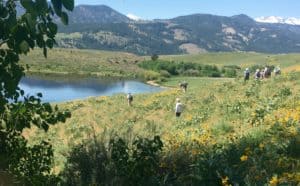
The Institute is venturing over to eastern Washington the weekend of May 15-16 for a very special field excursion with biologist and geologist Mark Darrach. “Bunchgrass Dreams: High Desert Ecology” explores the Arid Land Ecology Reserve, located within the Hanford Nuclear Reservation near the Tri-Cities in Eastern Washington, which is the largest remnant of native sagebrush-steppe habitat in the state. An unspoiled refuge for an indigenous landscape disappearing throughout the intermountain West, the ALE is home to an entire community of diverse and unique plants, reptiles, birds and mammals, including Rattlesnake Mountain milk-vetch, Rocky Mountain elk, Piper’s daisies, burrowing owls, sagebrush lizards, Swainson’s hawks and more than 45 species of butterflies.

This excursion is extra-special because the ALE is off-limits to the general public and there are very few guides that have permission to enter it. We’re very fortunate that Mark has access to this landscape and is willing to lead an Institute exploration for us. There are a handful of spots still open for registration — you can sign up via our website or by calling Kacey at (360) 854-2599.

And finally, here are an Institute staffer’s reflections from attending this field excursions a few years ago:

Our weekend on Rattlesnake Mountain is one I will never forget. I’d seen that mysterious hump across the shrub steppe ranchland of southeastern Washington as I criss-crossed the state by car, but never knew much about it.  It’s big! At more than 3,500 feet, it’s one of the tallest, treeless mountains in the world and you can see vast stretches of Washington from its crown. It’s also impossible for casual hikers to visit because access to it is very limited. The Institute’s entree under Mark Darrach’s guidance is something special. When Mark unlocked the access road gate at the foot of the mountain, and we quietly entered, I felt like we were being allowed “backstage” into one of the most mysterious and complex landscapes in the Northwest.

The mountain is a convergence of culture, natural history, politics and botany and I can’t imagine anyone knows more about it than Mark Darrach. We spent two days with him and the questions and conversations ranged widely; I don’t believe we ever asked him a question that he couldn’t answer. A luxury of intellect in a remarkable natural setting.

–Kris Molesworth (Photos by Carl Molesworth)

Trailside participants

Rocking the old growth

January 15th, 2010 | Posted by in Field Excursions

Sometimes we think in order to see new things that we need to travel to the furthest reaches of our earth.

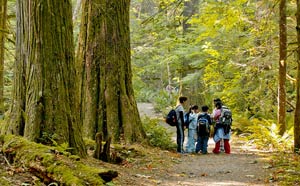
I was reminded of how wrong this train of thought is last Saturday as I traveled 40 minutes downriver to Rockport State Park. Rockport is a small place, blink while driving across Highway 20 East to the Cascades and you might well miss it. However, being small and little known should not suggest that this State Park has nothing to offer. In fact, you would be hard pressed to find a more easily accessible example of old growth forest anywhere in the Cascades.

Old GrowthThat which we do not speak of makes its presence known

» Continue reading Rocking the old growth

01-Jason Ruvelson

Capturing the Cascades

September 28th, 2009 | Posted by in Field Excursions

Over the second weekend in September, 12 photographers joined me (Benj Drummond) at the Learning Center for a weekend seminar on digital photography. We enjoyed clear sunny days and took advantage of the beautiful fall light from dawn until dusk (and then kept shooting). After returning from the field, we edited and tweaked our images in the computer lab. On Sunday we wrapped up the weekend with a group critique of the weekend’s work. Below are a selection of favorites, though it was a hard edit to make!

Above © Jason Ruvelson

02-RussDalton

© Russ Dalton

03-SeatonGras

© Seaton Gras

04-EdGastellum

© Ed Gastellum

05-EmilyWeisberg

© Emily Weisberg

06-ShelleyLangton

© Shelley Langton

07-DavidGreen

© David Green

08-LouiseKornreich

© Louise Kornreich

09-BethWisotzkey

© Beth Wisotzkey

10-DonFisher

© Don Fisher

12-SeatonGras

© Seaton Gras

Stories in Stone

September 22nd, 2009 | Posted by in Field Excursions

DSC04188Pioneer Building with 50-million-year old sandstone from Bellingham, specifically from the Chuckanut quarries.

Guest post by David Williams

(David Williams is leading “Seattle’s Wild Side: Natural History in the Streets” tour on Saturday, Sept. 26. Sorry, the tour is full!)

As a hard-core geogeek, I often need a fix of rock.  Since I cannot always get up into the mountains to check out our wonderful geology, I regularly head downtown in search of stone.  This may seem odd but in Seattle I can find rock ranging in age from 3.5-billion-years old to less than 80,000 years old.  I can touch rocks from places as diverse as South Africa, Germany, Italy, Brazil, and Finland, as well as Indiana, Minnesota, Washington, and California.  I can gaze at fossils as big as a cinnamon roll and ones that resemble an ice cream cone.  And if those fossils drive my hunger, I can even find those foods nearby, something I cannot do in the field.

I first became infatuated with building stone in the Metro bus tunnels.  Under Westlake Mall I found a spectacular rock that looks like a marble cake.  I later learned it was the oldest commonly used building stone in the world and that it was a popular building material during the period when Art Deco architecture was popular.  As I began to look at stone in other buildings, I continued to find interesting connections between rock and people.

For example, when Seattle burned to the ground during its Great Fire of 1889, stone replaced wood as the main building material.  You can see this in the older parts of the city around Pioneer Square where 50-million-year old sandstone quarried in Bellingham, Wilkeson, and Tenino and a 33-million-year old granite from Index make up many of the buildings.  The stones were popular because they could easily be transported to Seattle and withstood erosion.

Following the fire, as city residents became wealthier they sought out stone from further and further away.  Limestone from Indiana, serpentine from Vermont, and gneiss from Minnesota first appear in buildings in the late 1920s.  Now, as noted above, stone arrives in Seattle from all over the world, which makes geologists such as myself quite giddy.  These are some of the stories that I have written about over the years as an urban naturalist. I will tell a few more and lead us to some of my favorite stories in stone on my program.